

BSEC: Bangladesh Securities & Exchange Commission Guide
When Markets Fail, Regulators Define the Difference
In October 1996, Bangladesh’s stock market collapsed. Retail investors — thousands of them — had poured life savings, borrowed capital, and retirement funds into equities during a speculative bubble that authorities failed to contain in time. When prices crashed, the financial devastation was not merely statistical. It was personal, generational, and systemic.
The same scenario repeated in 2010–2011 with devastating precision. Once again, market manipulation, regulatory gaps, disclosure failures, and inadequate enforcement created conditions where ordinary investors bore catastrophic losses that sophisticated actors largely avoided.
Both crises share a common thread: the absence of a sufficiently empowered, independent, and operationally capable regulatory institution. The Bangladesh Securities and Exchange Commission (BSEC) was created precisely to be that institution — and its evolution since those crises reflects the ongoing project of building a capital market that serves investors rather than exploits them.
This guide examines BSEC in full — its meaning, mandate, legal architecture, regulatory functions, enforcement powers, and its central role in governing the Bangladesh Stock Market across both the DSE and CSE.
BSEC Full Meaning: Unpacking the Name and the Mission
What Does BSEC Stand For?
BSEC stands for Bangladesh Securities and Exchange Commission. Each word in that name carries precise institutional significance:
- Bangladesh — The commission’s jurisdiction is exclusively national, covering all securities markets, market participants, and capital market activities within the territorial boundaries of Bangladesh
- Securities — The regulatory subject matter encompasses all financial instruments classified as securities: shares, debentures, bonds, mutual fund units, derivatives, and related instruments
- Exchange — Direct reference to the organized marketplace infrastructure — principally the Dhaka Stock Exchange (DSE) and the Chittagong Stock Exchange (CSE) — over which BSEC maintains supervisory authority
- Commission — Denotes a collegial decision-making body with statutory independence, as opposed to a ministerial department subject to direct political direction
Together, BSEC’s full meaning resolves to: the statutory independent commission responsible for regulating all securities-related activities and market infrastructure across Bangladesh’s capital market ecosystem.
Organizational Identity at a Glance
| Attribute | Detail |
|---|---|
| Full Name | Bangladesh Securities and Exchange Commission |
| Abbreviation | BSEC |
| Type | Statutory regulatory body |
| Established | 1993 (under the Securities and Exchange Commission Act, 1993) |
| Headquarters | Agargaon, Sher-e-Bangla Nagar, Dhaka, Bangladesh |
| Parent Ministry | Ministry of Finance, Government of Bangladesh |
| Governing Legislation | Securities and Exchange Commission Act, 1993 |
| Official Website | sec.gov.bd |
Legal Foundation: The Statutory Architecture of BSEC
The Securities and Exchange Commission Act, 1993
The Bangladesh Securities and Exchange Commission was formally established under the Securities and Exchange Commission Act of 1993, enacted by the Government of Bangladesh to create a dedicated, independent regulatory institution for the capital market. Prior to this legislation, securities market oversight was fragmented across multiple agencies without a unified regulatory command structure.
The 1993 Act granted BSEC:
- Statutory independence from day-to-day ministerial direction
- Quasi-judicial powers to adjudicate disputes and impose penalties
- Rule-making authority to issue binding regulations, circulars, and guidelines
- Licensing powers over market intermediaries including brokers, merchant banks, and asset managers
- Investigation and enforcement authority over market misconduct and securities law violations
Subsequent Legislative Amendments
The regulatory framework has been strengthened through successive amendments:
- Securities and Exchange Ordinance, 1969 — Pre-BSEC foundational legislation still partially operative for historical securities provisions
- Securities and Exchange Commission (Amendment) Act, 2012 — Significantly expanded BSEC’s enforcement powers, increased penalties for market manipulation, and introduced provisions aligned with post-2010 crash reform recommendations
- Demutualization Act, 2013 — Directed and authorized the conversion of DSE and CSE from member-owned associations to publicly listed companies under BSEC’s supervisory framework
- Mutual Fund Rules, 2001 and subsequent amendments — Established the regulatory framework for collective investment schemes
Core Mandate: What BSEC Is Legally Required to Do
The Bangladesh Securities and Exchange Commission operates under a tripartite statutory mandate that governs all of its activities:
1. Investor Protection
The protection of securities investors constitutes BSEC’s primary and non-negotiable obligation. This encompasses:
- Ensuring full and fair disclosure by issuers — all material information affecting investment decisions must be publicly disclosed
- Prohibiting fraudulent and manipulative practices — insider trading, price rigging, circular trading, and pump-and-dump schemes are explicitly prohibited and actively investigated
- Maintaining grievance redressal mechanisms — investors who suffer harm as a result of market misconduct have formal channels for complaint and compensation
- Enforcing conduct standards on market intermediaries — brokers, portfolio managers, and investment advisers are held to fiduciary and professional standards of conduct
2. Capital Market Development
BSEC carries an explicit development mandate alongside its regulatory one:
- Expanding the product range available in the Bangladesh capital market — derivatives, ETFs, REITs, green bonds, and sukuk have all been introduced or piloted under BSEC’s development agenda
- Deepening market liquidity by broadening the investor base through financial literacy programs and diaspora investment facilitation
- Facilitating IPO processes that bring new issuers into the public market efficiently and transparently
- Strengthening market infrastructure — including trading technology, settlement systems, and depository services
3. Maintaining Market Integrity
Market integrity — the condition in which all participants can trust that prices reflect genuine supply-demand dynamics rather than manipulation — is the systemic goal that encompasses both investor protection and development:
- Surveillance systems monitor trading patterns for anomalies indicative of manipulation
- Enforcement actions against violators create deterrence that sustains the credibility of the entire market
- Coordination with Bangladesh Bank, NBR, and international regulators strengthens cross-border and cross-sector market integrity
BSEC’s Regulatory Scope: What Falls Under Its Authority
Entities and Institutions Regulated by BSEC
The Bangladesh Capital Market regulatory perimeter extends across a broad institutional landscape:
Exchanges and Infrastructure:
- Dhaka Stock Exchange (DSE)
- Chittagong Stock Exchange (CSE)
- Central Depository Bangladesh Limited (CDBL)
Market Intermediaries:
- Stockbrokers and stock dealers
- Merchant banks and investment banks
- Portfolio managers and discretionary investment advisers
- Credit rating agencies
- Trustees and custodians
- Clearing and settlement agents
Collective Investment Vehicles:
- Closed-ended mutual funds
- Open-ended mutual funds
- Alternative Investment Funds (AIFs)
Issuers:
- All public limited companies listed on DSE or CSE
- Bond and debenture issuers
- Mutual fund sponsors and asset management companies
Instruments Under BSEC Oversight
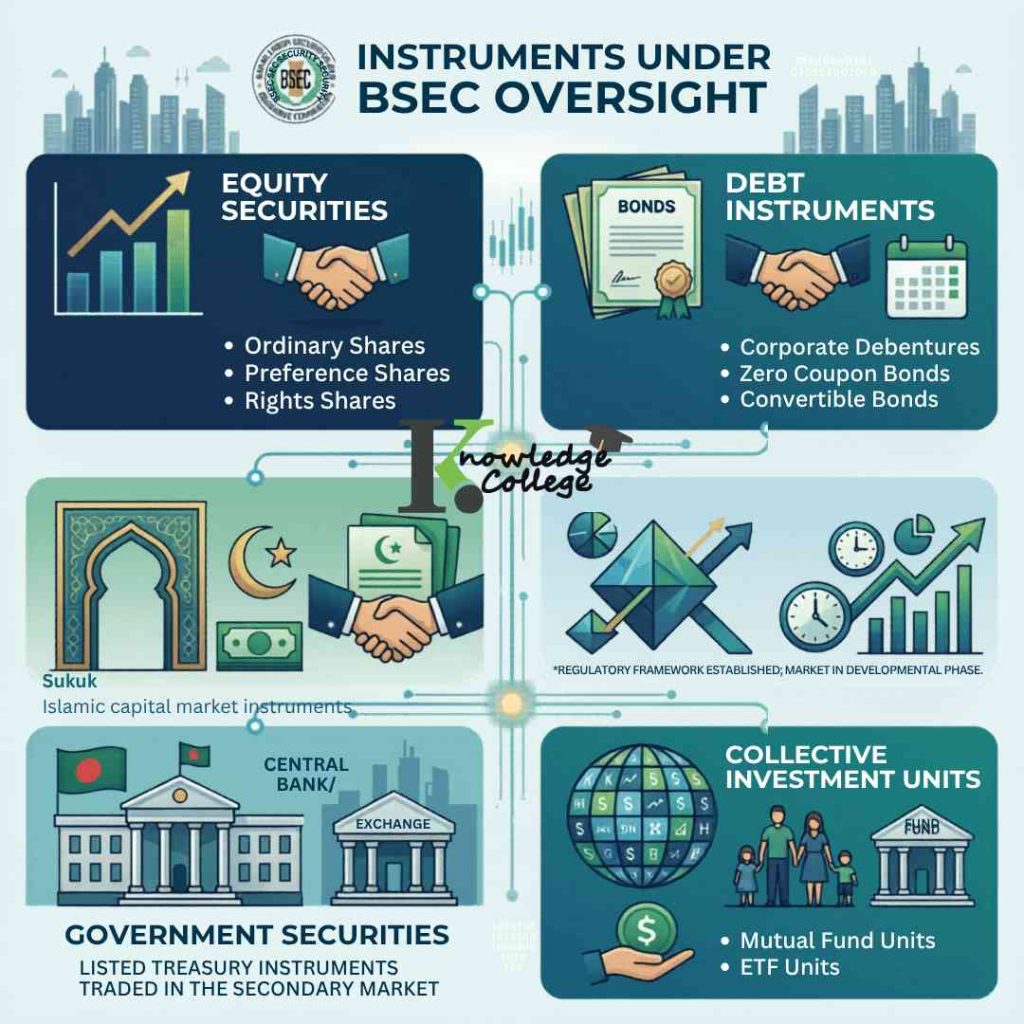
- Equity securities — ordinary shares, preference shares, rights shares
- Debt instruments — corporate debentures, zero coupon bonds, convertible bonds
- Collective investment units — mutual fund units, ETF units
- Government securities — listed treasury instruments traded in the secondary market
- Sukuk — Islamic capital market instruments regulated under BSEC’s Islamic finance framework
- Derivatives — futures and options (regulatory framework established; market in developmental phase)
How BSEC Governs the Bangladesh Stock Market
Listing Regulations: The Gateway to the Public Market
Any company seeking to list its shares on the Bangladesh Stock Market — whether on DSE or CSE — must satisfy BSEC’s listing requirements. These include:
- Minimum paid-up capital thresholds specific to the listing category
- Profitability track record requirements for main board listing
- Prospectus disclosure standards mandating complete financial, operational, and risk information
- Lock-up restrictions on pre-IPO shareholders to prevent immediate post-listing sell-offs
- Underwriting requirements ensuring minimum subscription levels are achieved
BSEC reviews, approves, or rejects all IPO applications, sets the offer price band where applicable, and approves the final prospectus before public distribution.
Continuous Disclosure Obligations
Post-listing, BSEC mandates ongoing disclosure from all listed entities:
- Quarterly financial statements — unaudited accounts published within 45 days of quarter-end
- Annual reports — audited accounts with full management discussion and analysis
- Price-sensitive information disclosures — any material development affecting share price must be disclosed immediately
- Dividend announcements — formal regulatory disclosures required within specified timelines
- Corporate action notices — rights issues, bonus shares, mergers, acquisitions, and directorial changes
Market Surveillance
BSEC operates a continuous market surveillance function using automated monitoring systems that flag:
- Unusual trading volume spikes in specific securities
- Price movements inconsistent with publicly available information
- Patterns consistent with coordinated buying or selling (indicative of price manipulation)
- Trading by individuals with potential access to material non-public information
When surveillance flags a potential violation, BSEC initiates a formal inquiry that can escalate to a full investigation and, where evidence warrants, enforcement action.
BSEC’s Enforcement Powers: Consequences for Market Misconduct
Investigative Authority
BSEC’s enforcement division possesses statutory authority to:
- Demand documents and records from any regulated entity or market participant
- Summon individuals for examination under oath
- Freeze accounts and assets suspected of being proceeds of market manipulation or fraud
- Coordinate with law enforcement agencies including the Bangladesh Financial Intelligence Unit (BFIU) and relevant judicial authorities
Penalty and Sanction Framework
| Violation Category | Potential Sanctions |
|---|---|
| Insider trading | Fines up to ৳50 million; imprisonment up to 5 years |
| Market manipulation | Fines up to ৳50 million; trading ban; criminal prosecution |
| Disclosure violations | Fines per day of non-compliance; trading suspension |
| Unlicensed intermediary activity | Fines; permanent market bar; criminal referral |
| Prospectus fraud | Civil and criminal liability; issuer sanctions |
| Broker misconduct | License suspension or cancellation; fines |
Quasi-Judicial Adjudication
BSEC functions as a quasi-judicial body for securities law matters. It can:
- Issue show-cause notices to alleged violators
- Conduct formal adjudicatory hearings with rights of representation
- Issue final orders with findings of fact and prescribed penalties
- Decisions are subject to appeal before the Securities Appellate Tribunal and subsequently before the High Court Division
Expert Insight: BSEC’s Institutional Evolution in Comparative Context
Effective securities regulation requires three non-negotiable attributes: statutory independence that insulates the regulator from political interference, adequate financial resources to attract and retain expert staff, and credible enforcement that creates genuine deterrence rather than performative compliance. BSEC has made measurable progress on all three dimensions since the 2012 legislative reforms — but the benchmark must be global best practice, not historical comparison. The International Organization of Securities Commissions (IOSCO) Principles provide the appropriate framework for evaluating where structural gaps remain, particularly in derivative market oversight and cross-border regulatory cooperation.
— Analytical perspective consistent with World Bank and IMF Financial Sector Assessment Program (FSAP) frameworks applied to frontier market securities regulators.
Tweet
BSEC became a signatory member of IOSCO — the global standard-setting body for securities regulation — a milestone that formally integrated Bangladesh’s capital market regulatory framework into the international supervisory architecture. This membership facilitates information sharing with foreign regulators, particularly relevant as non-resident Bangladeshi (NRB) investment in the domestic capital market expands.
BSEC’s Capital Market Development Initiatives
Financial Literacy and Investor Education
BSEC has institutionalized investor education as a regulatory function, operating programs that include:
- National financial literacy campaigns conducted through media partnerships
- Regional investor education seminars targeting non-Dhaka investor populations
- University-level capital market awareness programs to develop the next generation of market participants
- Digital content initiatives accessible through BSEC’s official portal
Product Innovation and Market Deepening
Under BSEC’s developmental mandate, several structural market enhancements have been introduced:
- Exchange Traded Funds (ETFs) — introduced to provide diversified, low-cost investment vehicles
- Real Estate Investment Trusts (REITs) — regulatory framework established to enable property sector capital market participation
- Green Bonds and Sukuk — Islamic and sustainable finance instruments introduced to broaden issuer and investor diversity
- SME Boards on both DSE and CSE — dedicated platforms with relaxed listing criteria enabling smaller enterprises to access public capital
- Alternative Investment Fund (AIF) Regulations — framework for private equity and venture capital funds operating within the regulated perimeter
Non-Resident Bangladeshi (NRB) Investment Facilitation
BSEC has introduced specific regulatory accommodations to attract diaspora capital into the Bangladesh capital market:
- Simplified BO account opening procedures for NRBs through designated banks and brokers
- Repatriation rights for investment returns in foreign currency
- Dedicated NRB investment windows and information portals
Common Myths About BSEC — Corrected
Myth 1: “BSEC controls share prices on the DSE and CSE”
Reality: BSEC does not set, fix, or control the market price of any security. Share prices are determined by market supply and demand through the exchanges’ auction mechanisms. BSEC’s price-related interventions are limited to circuit breakers — temporary trading halts designed to prevent extreme intraday volatility — and IPO price band approvals. Day-to-day price discovery remains entirely market-driven.
Myth 2: “BSEC approval of an IPO means the investment is safe”
Reality: BSEC’s IPO approval is a disclosure review, not an investment endorsement. The commission verifies that the prospectus contains complete, accurate, and material information. It does not validate the business quality, financial projections, or investment merits of the issuing company. Investors bear full responsibility for evaluating investment risk.
Myth 3: “BSEC only matters to large institutional investors”
Reality: Every retail investor who opens a BO account, purchases shares on the DSE or CSE, invests in a mutual fund, or responds to an IPO is directly protected by BSEC’s regulatory framework. The conduct standards, disclosure mandates, and enforcement actions that BSEC administers are specifically designed to level the informational playing field between retail and institutional participants.
Myth 4: “Filing a complaint with BSEC produces no result”
Reality: BSEC maintains a formal investor complaint management system. While outcomes vary based on evidence and legal jurisdiction, BSEC has a documented track record of investigations initiated from retail investor complaints. The commission’s enforcement division is mandated to respond to and process formal complaints within defined timelines.
Myth 5: “BSEC and Bangladesh Bank are the same regulatory authority”
Reality: These are entirely separate institutions with distinct mandates. Bangladesh Bank is the central bank responsible for monetary policy, banking sector regulation, and foreign exchange management. BSEC regulates the capital market — stocks, bonds, mutual funds, and exchanges. Their jurisdictions overlap only in limited areas such as bank-affiliated brokerage and merchant banking operations, where both institutions coordinate oversight.
💡 Pro-Tip: How to Use BSEC Resources as an Investor
The BSEC official website (sec.gov.bd) is significantly more useful to ordinary investors than most people realize. Beyond regulatory notifications, it provides:
- Enforcement orders — searchable records of all penalties and sanctions imposed; review these before engaging with any broker or intermediary
- Licensed intermediary registry — verify that your broker, portfolio manager, or merchant bank is currently licensed before transferring any capital
- Approved prospectuses — access complete IPO documentation before subscribing to any new issue
- Investor complaint portal — submit formal grievances against regulated entities through an official documented channel
- Regulatory circulars — stay current on rule changes that affect trading conditions, tax treatment, and disclosure requirements
Conclusion: Why the Bangladesh Securities and Exchange Commission Is the Cornerstone of Capital Market Trust
A stock exchange without a regulator is not a market — it is a venue for information asymmetry exploitation. The Bangladesh Securities and Exchange Commission (BSEC) exists to prevent precisely that outcome.
Through its investor protection mandate, development agenda, and enforcement authority, BSEC constitutes the institutional foundation upon which both the DSE and CSE derive their legitimacy. Every IPO that provides accurate information, every insider trading investigation that deters manipulation, every mutual fund regulation that protects small savers — these are expressions of BSEC’s operational mandate translated into market outcomes.
For beginners, understanding BSEC means understanding what protects you as an investor and what recourse you have when things go wrong. For C-suite executives, it means understanding the compliance architecture within which capital-raising, disclosure, and corporate governance obligations operate. For hobbyists and analysts, it means understanding the regulatory variable that shapes every structural feature of the Bangladesh capital market.
The Bangladesh Securities and Exchange Commission is not a bureaucratic formality. It is the difference between a capital market that earns investor trust and one that perpetually destroys it. Understanding its role is not optional for anyone who participates in, analyzes, or depends upon the Bangladesh stock market.
📌 BSEC Quick Reference
- Full Name: Bangladesh Securities and Exchange Commission
- Established: 1993
- Headquarters: Agargaon, Sher-e-Bangla Nagar, Dhaka
- Governing Law: Securities and Exchange Commission Act, 1993
- Regulated Exchanges: DSE (Dhaka Stock Exchange), CSE (Chittagong Stock Exchange)
- Depository Oversight: Central Depository Bangladesh Limited (CDBL)
- International Membership: IOSCO (International Organization of Securities Commissions)
- Official Website: sec.gov.bd
- Complaint Portal: Available via sec.gov.bd/investor-complaint
This article is intended for informational and educational purposes only. It does not constitute legal advice or investment guidance. For regulatory compliance matters, consult a BSEC-licensed legal or financial professional.