

Bangladesh Bank Rate Cut 2026: What DSE Investors Must Know
by Admin-KCBD · Published · Updated
July 30, 2026 was a date quietly circled on the calendars of most serious Bangladesh capital market watchers. That afternoon, the Bangladesh Bank’s Monetary Policy Committee convened for its 13th meeting and announced what many had been waiting for — a 50 basis point cut to the policy repo rate, bringing it down from 10% to 9.5%, effective August 2, 2026. It was the country’s first policy rate reduction in six years, ending a 21-month tightening cycle that had squeezed private credit to a 20-year low of just 4.98% by May 2026.
Dhaka Stock Exchange: Complete Investor GuideIf you’ve been watching the Dhaka Stock Exchange (DSE) closely over the past six weeks, you’ll know the market’s reaction has been anything but straightforward. The Bangladesh Bank rate cut DSE impact has played out in a volatile, back-and-forth fashion — and understanding exactly why matters enormously for how you position your portfolio right now.
Why Bangladesh Bank Cut Rates Now: The Full Picture
The central bank’s pivot was driven by a convergence of pressures that had been building since early 2026. Private sector credit growth had collapsed to historic lows, businesses were struggling to borrow affordably, and the high-interest-rate environment — designed to fight inflation — was throttling real economic activity.
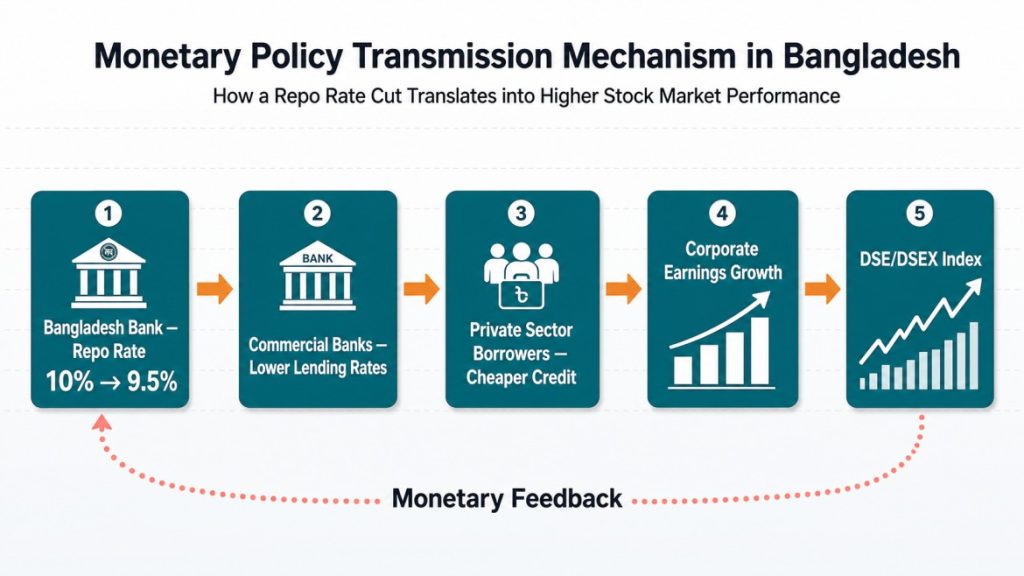
Inflation, while still elevated at 9.4% in May 2026, had shown a clear easing trajectory, giving the central bank the breathing room it needed. The Monetary Policy Committee also noted that excess liquidity in the banking system had surged by nearly 40% year-on-year by June 2026 — meaning banks were sitting on cash they weren’t deploying productively. The rate cut was, in essence, the Bangladesh Bank nudging that idle capital back into the real economy.
Alongside the repo rate reduction, the Standing Lending Facility (SLF) rate was cut by 50 basis points to 11%, while the Standing Deposit Facility (SDF) rate was held steady at 7.5%. This asymmetric adjustment was deliberate: it widened the corridor slightly to discourage banks from parking excess funds at the central bank and pushed them toward productive lending.
How the Rate Cut Is Actually Affecting DSE in September 2026
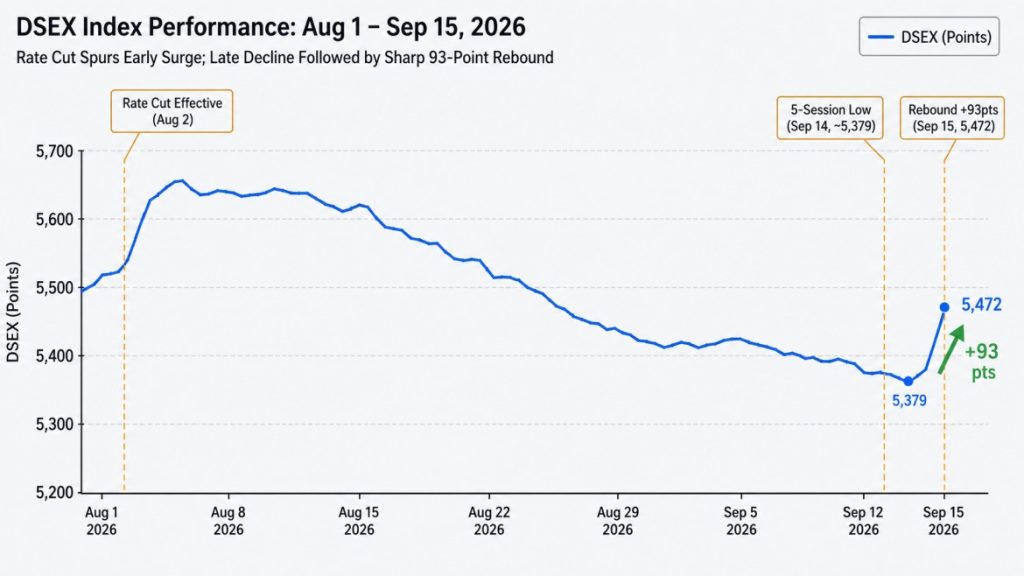
Here’s where it gets interesting — and a little counterintuitive. If you expected the DSE to soar following the rate cut, September 2026 has been a reality check. The DSEX opened September at 5,637 on September 1, fueled by early optimism and bargain hunting. But by September 14, following a bruising five-session losing streak, the index had slid below 5,400 — a three-month low.
The September 15 rebound, when the DSEX clawed back 93 points to close at 5,472, illustrated the market’s core tension: bargain hunters see genuine value in beaten-down stocks, but sellers keep returning every time macro headwinds resurface.
What’s driving the disconnect between a rate cut and a sluggish market? Three factors stand out. First, inflation remains elevated — August 2026 saw CPI at 8.26%, well above the Bangladesh Bank’s medium-term target. Investors know that if inflation re-accelerates, the rate-cutting cycle could pause or reverse, capping equity upside. Second, the industrial energy crisis — persistent gas and electricity supply shortages — is hammering the earnings outlook for manufacturing and textile companies, which account for a significant share of the DSE’s listed companies. Third, the BSEC’s regulatory scrutiny of abnormal price movements in specific stocks has added a layer of caution, as investors worry about sudden trading restrictions.
What Smart Investors Are Doing Right Now
Despite the near-term turbulence, the rate cut creates specific sectoral opportunities that are worth understanding in depth.
Banking stocks are the most direct beneficiary. Lower repo rates reduce banks’ short-term funding costs. For banks that are disciplined about passing on savings to borrowers while maintaining spreads, net interest margins can actually improve — particularly as they deploy previously idle excess liquidity into higher-yield loans. The DSE’s banking index has shown relative resilience compared to the broader market, and analysts at Capital Alliance have maintained a longer-term constructive view on the sector.
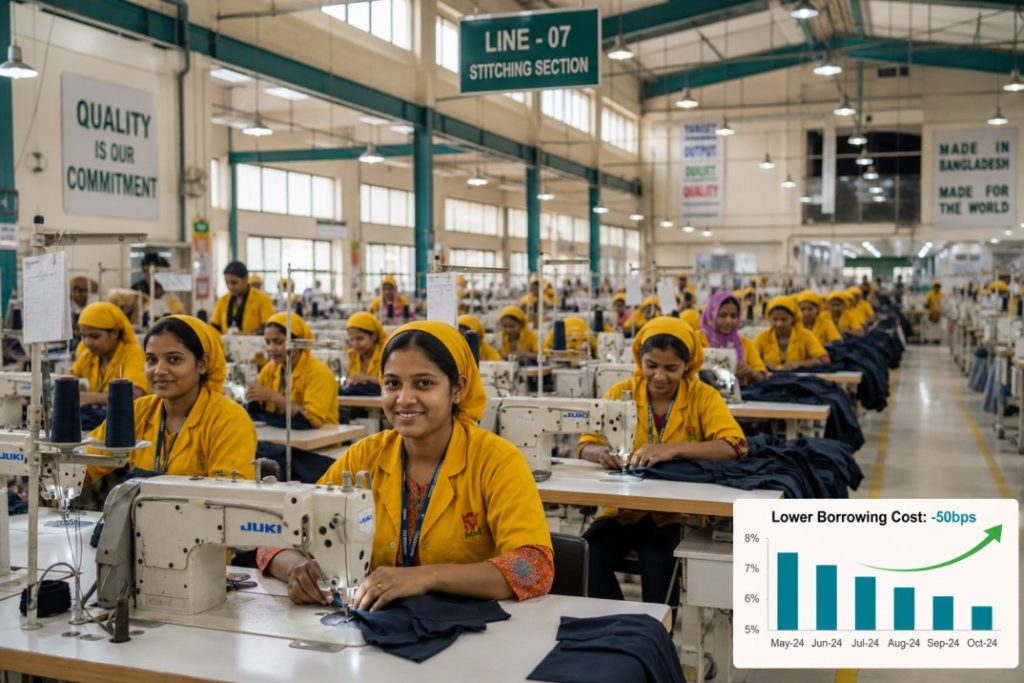
SME-linked companies stand to gain as commercial banks reduce lending rates by 50 to 100 basis points in response to the central bank’s move. Businesses in textiles, pharmaceuticals, and food processing that depend on working-capital loans will see their cost structures improve, potentially lifting profit margins and, in turn, earnings per share for their listed parent companies.
Fixed-income investors face a different equation. With deposit rates adjusting downward, savers are increasingly facing negative real returns — their deposit interest fails to keep pace with an 8.26% inflation rate. This is actually a structural tailwind for equities, as it incentivises capital migration from bank deposits into the stock market.
Future Outlook: Rate Cut Tailwinds vs. Macro Headwinds
The Bangladesh Bank rate cut DSE impact over the next 12 months will depend heavily on two things: whether inflation continues its descent toward the central bank’s target, and whether the industrial energy crisis gets resolved. If gas and electricity supply constraints ease — as the government has asserted they will — corporate earnings could surprise to the upside in Q4 2026 and Q1 2027. That’s the scenario where the rate cut’s benefits fully materialise in equity prices.
If, however, inflation proves sticky or energy disruptions persist, expect the DSE to remain in its current tug-of-war mode — periodic bargain-hunting rallies followed by profit-taking and macro-driven sell-offs. In that environment, stock selection will matter far more than broad market exposure.
For investors navigating this transition, a few principles stand out. First, focus on companies with low debt loads that benefit from falling rates without needing new borrowing to survive. Second, monitor the quarterly earnings reports of DSE-listed banks in October 2026 closely — their net interest margin data will be the clearest signal of whether the rate cut is genuinely flowing through. Third, maintain some liquidity: the DSE’s volatility in September 2026 has shown that re-entry opportunities will come.
The Bangladesh Bank rate cut is a genuine inflection point. After six years of tightening, the direction of monetary policy has changed. How quickly that change feeds into corporate profits, investor sentiment, and ultimately the Bangladesh Bank rate cut DSE impact on your portfolio will unfold over the coming quarters — and the investors who understand that timeline will be best positioned to benefit.
Frequently Asked Questions
Q: How does the Bangladesh Bank rate cut directly affect the DSE? A: A lower repo rate reduces borrowing costs for commercial banks, which can improve bank profit margins and stimulate credit growth to businesses. As companies access cheaper capital, earnings expectations rise, which typically supports higher stock valuations on the DSE. However, the effect is gradual — usually taking 2–3 quarters to fully transmit.
Q: Why hasn’t the DSE surged immediately after the rate cut? A: Markets price in anticipated changes ahead of actual policy moves. Crucially, Bangladesh’s September 2026 market faces competing headwinds — elevated inflation (8.26%), industrial energy shortages, and cautious investor sentiment — that are offsetting the positive monetary signal. Bargain hunting is providing floor support, but sustained gains require these macro obstacles to ease.
Q: Which DSE sectors benefit most from the repo rate cut? A: Banking stocks benefit most directly through improved funding costs. SME-lending-focused banks and non-bank financial institutions (NBFIs) also gain. Indirectly, capital-intensive sectors like textiles, pharmaceuticals, and FMCG benefit as their borrowing costs decline.
Q: Is this a good time to buy DSE stocks? A: The combination of a rate-cutting cycle beginning and valuations compressed by recent selling creates a potentially attractive entry window. However, stock selection is critical — focus on fundamentally strong companies in banking, consumer staples, and export-oriented manufacturing. Never invest money you cannot afford to keep invested for at least 12–18 months given current volatility.
Q: What is the current DSEX level and where might it go by 2027? A: As of September 15, 2026, the DSEX closed at 5,472 after recovering 93 points. Capital Alliance and other market analysts project potential growth toward the 6,000–6,500 range by mid-2027, contingent on macroeconomic stabilisation, easing inflation, and resolution of the industrial energy crisis.
Q: Will Bangladesh Bank cut rates further in 2026? A: Bangladesh Bank’s MPC has signalled a data-dependent approach. If August and September inflation data confirm a continued easing trend and credit growth responds positively to the first cut, a second reduction of 25–50 basis points in Q4 2026 is plausible. Investors should monitor MPC meeting dates and inflation releases closely.