Credit Cards in Bangladesh: A Daily Financial Lifeline
by Admin-KCBD · Published · Updated
For a long time, a bulging wallet full of cash was the best way to show off your wealth in Dhaka. It was a clear sign of how much money you had. But by 2026, the Bangladeshi consumer’s wallet has gotten a lot smaller and has been replaced by a sleek cardholder, driven by the rapid rise of credit cards in Bangladesh. This change from paper notes to high-quality plastic and titanium is more than just a change in looks; it changes the country’s economy in a big way, making luxury more accessible and connecting Bangladeshi consumers to the global economy. The ecosystem of credit cards in Bangladesh, which was once feared as a “debt trap” in the early 2000s, has become a smart financial partner that helps people navigate a fast-changing economy by combining AI, identity, and daily survival.
Table of Contents
The rise in adoption of credit cards in Bangladesh and changes in spending habits
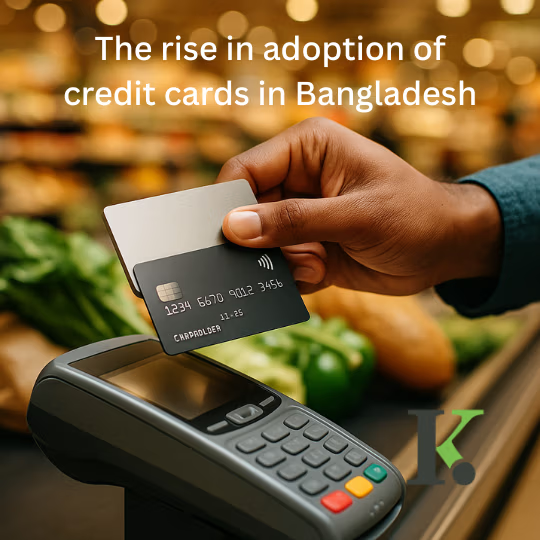
Bangladesh has seen a rapid rise in the use of card-based transactions. In the last five years, card-based transactions have grown by an incredible 228 percent. Debit cards are still the most popular type of card, with 47.1 million users by December 2025. However, credit cards have made a strong comeback. In just the last four years, the number of people who use credit cards has grown by 58%, from 1.833 million in 2021 to 2.886 million by the end of November 2025. There are 56 banks and one non-bank financial institution (NBFI) that offer card services in the country right now. Of these, 48 banks offer credit cards, dual-currency debit cards, and prepaid cards.
But the real change is in how these cards are used. The credit card has lost its aspirational quality. It used to be a way to travel internationally and shop for luxury items, but now it is just a useful tool for everyday life. Reports from the central bank and transaction data show a “supermarket surge.” Almost half of all credit card transactions in the US now happen at department stores and grocery stores. This trend was very clear in November 2025, when domestic spending patterns showed a strong preference for shopping in stores. Department stores made up 45% (Tk1,589 crore) of all domestic card spending. In a world where inflation changes and the cost of living puts constant pressure on families, using short-term credit to get by until payday is no longer a luxury; it’s a smart move.
The Power of EMI: Making Dreams Come True with credit cards in Bangladesh
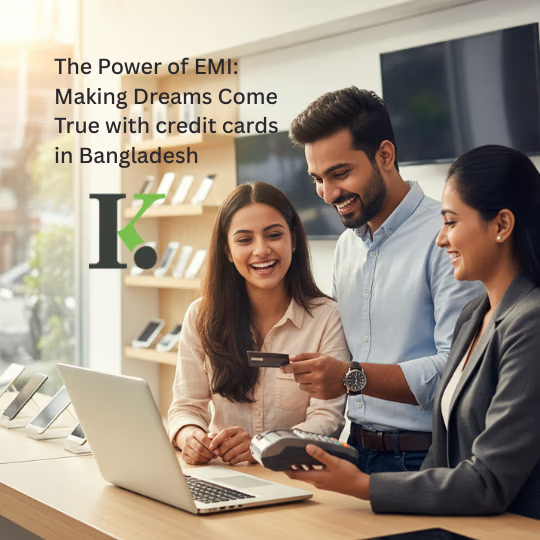
The credit card’s biggest success in the local market may not have been the credit itself, but the “Equated Monthly Installment” (EMI) culture it started. EMI facilities have become a way for consumers to connect their dreams with what they can actually afford. It has been a game-changer for the growing middle class to be able to buy expensive things like a refrigerator, a top-of-the-line smartphone, or a laptop without using up all of their savings each month. The credit card has made household cash flows less volatile by breaking up big bills into smaller, interest-free payments (often through “No-cost EMI” options where banks and merchants pay the interest).
This flexibility is very important in a country where many people don’t have much money saved up. EMI lets people keep money on hand for things like rent, health care, or emergencies. It is also an important tool for small business owners. For example, Mahfuza Khanam Prottassha used EMI to buy professional kitchen equipment, which let her turn her baking hobby into a catering business without using up all of her working capital. For stores, offering EMI lowers the upfront cost, which turns indecision into sales and keeps stock moving. For banks, EMI is a carefully planned way to grow their business. It makes money through interest rates (on standard EMI plans) and processing fees, and it also keeps customers around longer and gives banks useful information about their customers.
How credit cards in Bangladesh Act as a Financial Lifeline During Emergencies
In Bangladesh, emergencies don’t usually give people a heads-up. Sudden trips to the hospital, urgent travel, or unplanned home repairs can throw a household’s budget way off. In these times, credit cards have become more and more important, going from being just a way to pay for things to being a vital financial lifeline.
The best thing about a credit card in an emergency is that it works right away. A credit card gives you access to money right away, without the need for paperwork or processing time like a personal loan does. This instant liquidity is especially important in medical emergencies, when private hospitals often require upfront deposits before starting treatment. With a simple card swipe, you can get in or get medication right away. Also, the interest-free grace period (which can last up to 45 days) lets people with jobs who are having trouble with their cash flow temporarily make up the difference and pay it back when they get their paycheck, without having to pay any extra fees. Knowing that money is available right away is a huge psychological comfort, in addition to the financial aspect. It lowers panic and lets people focus on solving the problem.
The Global Passport: How credit cards in Bangladesh Help You Get Around a World Without Borders
The credit card has become a “passport of the pocket” as more and more workers and customers in Bangladesh move around. In 2026, going on vacation without a dual-currency card is like flying without a map. It gets rid of the hassle of exchanging money and the worry of carrying a lot of cash. It works with everything from ride-sharing apps in New York to the London Underground.
Cross-border credit card spending has gone up a lot, which shows that people are more confident and active. In November 2025, cross-border credit card spending jumped 19% from the same month the year before. Bangladeshis spent Tk511 crore on 792,520 transactions abroad. Department stores made up 30.80% (Tk157.5 crore) of this spending abroad, and retail outlet services made up 17.33% (Tk88.6 crore). According to country-by-country trends, most Bangladeshi nationals used their cards in the United States (14%), Thailand, the United Kingdom (13%), and India. The central bank’s decision to make foreign currency transactions easier, like getting rid of complicated manual authorizations, shows that the government is keeping up with the speed of global trade.
The Future of credit cards in Bangladesh: More AI, More Security, and More Ethics

Today’s ease of use is based on huge advances in financial technology, such as moving from magnetic stripes to encrypted tokenization and biometric security, which make it almost impossible to intercept transactions. By 2030, Artificial Intelligence will turn credit cards from passive tools into active “financial concierges.” Machine learning systems will look at each person’s spending habits in real time and offer targeted rewards. They will also automatically group together services that are relevant (like travel insurance when booking flights) and even suggest EMI conversions to help with monthly cash flow. Security will move toward behavioral biometrics, which looks at how a person holds their phone or types to make security stronger than ever without being seen.
But the industry has to get past the “meager bracket.” More than 11.5 million Bangladeshis have Tax Identification Numbers, but only a small number of them can get credit cards. Banks are responding by making products that are only for certain groups, like teachers, healthcare workers, and young workers with steady but previously ignored income streams.
The risk of debt traps rises as credit becomes available to middle- and lower-middle-income users in a high-interest environment. Credit in the future needs to be moral. One way to do this is to use “RegTech,” which uses AI to warn people when they are getting too much debt or push them to save money.
In the end, the tale of credit cards in Bangladesh is one of change and power. They have made it possible for people to connect with what they need and want, as well as with people in their own area and around the world. While they used to be a mere sign of wealth, credit cards in Bangladesh are now a vital component of every grocery store trip and a way to move up the economic ladder. They let individuals buy items without going broke, give them a safety net in case of an emergency, and make it easier to get throughout the world.