
Dhaka Stock Exchange: Complete Investor Guide
The Problem Every Bangladeshi Investor Faces
Millions of Bangladeshis have capital sitting idle in low-yield savings accounts. They hear about the Dhaka Stock Exchange — friends who doubled their money, headlines about surging DSE index figures, and financial advisors recommending equity portfolios — yet most feel paralyzed. The terminology is opaque. The process seems inaccessible. The risks appear enormous.
That paralysis is expensive. Bangladesh’s economy has been among the fastest-growing in Asia for over a decade, and its primary capital market has been at the center of that growth story. Missing participation in that growth is not merely a missed opportunity — it is a compounding financial disadvantage.
This guide resolves that. Whether you are a first-time retail investor trying to understand DSE share price today, a C-suite executive evaluating equity financing, or a finance hobbyist tracking the DSE index — this comprehensive resource covers everything you need to know, from foundational history to operational mechanics.
What Is the Dhaka Stock Exchange?
The Dhaka Stock Exchange (DSE) is the principal stock exchange of Bangladesh, headquartered at Nikunja-2, Khilkhet, Dhaka. It is a demutualized public limited company regulated by the Bangladesh Securities and Exchange Commission (BSEC) under the Securities and Exchange Ordinance of 1969.
As the larger of Bangladesh’s two stock exchanges — the other being the Chittagong Stock Exchange (CSE) — the DSE serves as the primary platform through which:
- Companies raise long-term capital by listing shares and bonds
- Investors trade equity, mutual funds, and fixed-income instruments
- Price discovery of publicly listed securities occurs in real time
- Market capitalization data reflects the aggregate valuation of Bangladesh’s corporate sector
The exchange operates a fully automated, screen-based trading system and is a member of the World Federation of Exchanges (WFE) and the South Asian Federation of Exchanges (SAFE).
When Was the Dhaka Stock Exchange Established?
Origins and Founding History
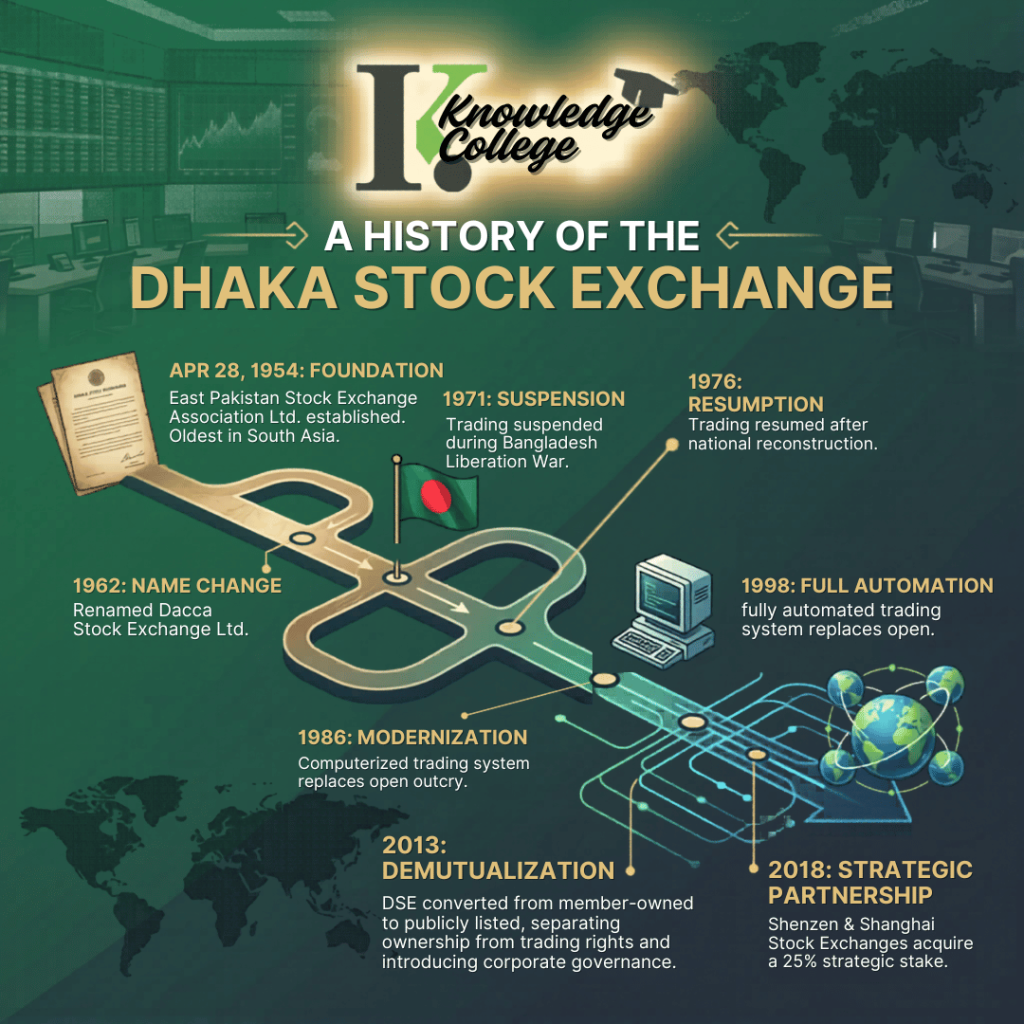
The Dhaka Stock Exchange was established on April 28, 1954, making it one of the oldest capital market institutions in South Asia. It was initially incorporated as the East Pakistan Stock Exchange Association Ltd., a direct reflection of the political geography of the time — pre-independence Bangladesh was then the eastern wing of Pakistan.
The exchange’s historical timeline reveals a complex evolution shaped by national transformation:
- 1954 — Formally established as the East Pakistan Stock Exchange Association Ltd.
- 1962 — Renamed the Dacca Stock Exchange Ltd. following administrative reorganization
- 1971 — Trading suspended during the Bangladesh Liberation War
- 1976 — Trading resumed after independence and national reconstruction
- 1986 — Introduction of computerized systems to modernize operations
- 1998 — Fully automated trading system implemented, replacing open outcry
- 2013 — Demutualization Act enacted; DSE converted from a member-owned entity to a publicly listed company
- 2018 — Shenzhen Stock Exchange and Shanghai Stock Exchange jointly acquired a 25% strategic stake in DSE, marking a landmark foreign institutional investment
This demutualization in 2013 was pivotal. It separated ownership from trading rights, introduced a corporate governance framework, and aligned DSE with global best practices.
Understanding the DSE Index: The Pulse of the Market
What Is the DSEX?
The DSEX (DSE Broad Index) is the flagship benchmark index of the Dhaka Stock Exchange. Launched in January 2013 in partnership with Standard & Poor’s, it replaced the older DSE General Index (DGEN). The DSEX tracks a broad universe of eligible listed companies and is calculated using a float-adjusted market capitalization methodology.
Key DSE Indices at a Glance
| Index | Description |
|---|---|
| DSEX | Broad market index; tracks all eligible securities |
| DS30 | Blue-chip index; top 30 companies by market cap and liquidity |
| DSES | Shariah-compliant index; screens for Islamic finance criteria |
| DSE SME Index | Tracks small and medium enterprises listed on the SME board |
How the DSE Index Is Calculated
The DSEX uses a base value of 2,957.07 (as of January 27, 2013) and adjusts daily based on the market capitalization of constituent stocks. The formula accounts for:
- Free float shares — only publicly tradable shares are included
- Price movement of individual constituents
- Corporate actions such as dividends, splits, and rights issues
Monitoring the DSE index daily provides investors with a macro-level view of market sentiment. A rising DSEX signals bullish conditions; a declining DSEX often reflects macroeconomic headwinds, policy changes, or global risk-off sentiment.
How DSE Share Price Today Works: Market Price Mechanics
Real-Time Price Discovery
The DSE share price today for any listed company is determined through a continuous auction mechanism during trading hours. The exchange operates on the following schedule:
- Continuous Trading: 10:00 AM – 2:20 PM
- Post-Closing Session: 2:20 PM – 2:30 PM
Prices move in response to buy and sell orders entered by brokers on behalf of investors. The market price of a share at any given moment reflects the last executed trade price.
Price Limits and Circuit Breakers
To prevent extreme volatility, the BSEC enforces:
- Daily price fluctuation limit: A maximum of ±10% movement from the previous closing price for most securities
- Index-level circuit breakers: Trading halts if the DSEX falls beyond a prescribed threshold within a single session
This mechanism protects retail investors from panic-driven crashes and is a standard feature of regulated markets globally.
Where to Check DSE Share Price Today
Investors can access live market price data through:
- The official DSE website —
- Licensed brokerage platforms and mobile trading apps like TradeFast, Royal Capital Ltd., etc.
- Financial portals such as Royal Capital Portal, Bloomberg, Reuters, and local equivalents
- CDBL (Central Depository Bangladesh Limited) for portfolio-level account data
Market Structure: How the DSE Is Organized
Listed Instruments
The DSE facilitates trading across multiple asset classes:
- Equity shares — ordinary and preference shares of listed companies
- Mutual funds — both open-ended and closed-ended schemes
- Debentures and bonds — corporate and government securities
- SME securities — shares of small and medium enterprises on a dedicated board
- ETFs (Exchange Traded Funds) — a growing segment introduced to diversify investment options
Market Segments
| Segment | Description |
|---|---|
| Main Board | Large-cap, well-established companies |
| SME Board | Smaller companies with relaxed listing criteria |
| ATB (Alternative Trading Board) | Non-compliant or Z-category companies |
Regulatory Architecture
The DSE operates within a multi-layered regulatory framework:
- Bangladesh Securities and Exchange Commission (BSEC) — apex securities regulator
- DSE Board of Directors — corporate governance body
- CDBL — central depository for electronic share custody
- ICB (Investment Corporation of Bangladesh) — state-owned investment institution that supports market stability
Expert Insight: DSE’s Strategic Position in South Asia
The demutualization of the Dhaka Stock Exchange and the subsequent entry of Chinese strategic investors represent a structural upgrade in institutional credibility. Markets that attract sophisticated foreign institutional participation tend to develop deeper liquidity pools and stronger price discovery mechanisms over time. DSE is positioned to be a significant emerging market destination in the 2030s — provided regulatory consistency and corporate governance standards continue to improve.
– Perspective consistent with assessments by Asian Development Bank (ADB) capital markets development reports on South Asian frontier markets.
Tweet
Bangladesh’s GDP growth trajectory — averaging above 6% annually for over a decade and targeting developed-nation status by 2041 — creates a structural tailwind for equity market expansion. The DSE market capitalization as a percentage of GDP, historically lower than regional peers, suggests significant room for deepening.
How to Invest in the Dhaka Stock Exchange
Step-by-Step Entry Process for New Investors
- Open a BO (Beneficiary Owner) Account with CDBL through a registered DSE broker or depository participant
- Complete KYC (Know Your Customer) documentation — NID, tax identification number (TIN), bank account details
- Open a trading account with a licensed DSE brokerage firm
- Fund the trading account via bank transfer
- Place buy orders through the broker’s online platform or in person at the brokerage office
- Monitor your portfolio via CDBL’s online portal and DSE’s official data feeds
💡 Pro-Tip: New investors should prioritize blue-chip DS30 constituents before exploring mid-cap or speculative stocks. The DS30 index companies have stronger corporate governance disclosures, audited financial statements, and more predictable dividend histories — reducing information asymmetry risk for those without deep market expertise.
Common Myths About the Dhaka Stock Exchange — Debunked
Myth 1: “The DSE is only for the wealthy”
Reality: There is no minimum investment threshold to open a BO account or purchase shares on the DSE. Fractional shares are not standard, but many listed companies have share prices accessible at a few hundred takas. Systematic investment — even at small amounts — is entirely viable.
Myth 2: “The DSE market is too volatile to trust”
Reality: All equity markets carry volatility. The DSE has experienced boom-and-bust cycles (notably in 1996 and 2010-2011), but post-demutualization regulatory reforms have significantly strengthened market integrity. Volatility is a risk management challenge, not a reason to avoid the market entirely.
Myth 3: “You need a broker physically present to trade”
Reality: The majority of DSE-licensed brokerage firms now offer online trading platforms and mobile applications, enabling investors to execute trades, monitor DSE share price today, and review account statements digitally from anywhere in the world.
Myth 4: “DSE share price today reflects a company’s true value”
Reality: Market price and intrinsic value are distinct concepts. A share trading at a high market price may be overvalued; a low-priced share may be deeply undervalued. Fundamental analysis — examining earnings, debt levels, return on equity, and sector outlook — is essential for rational investment decisions.
DSE’s Role in Bangladesh’s Economic Development
The Dhaka Stock Exchange is not merely a trading venue — it is a critical infrastructure component of national economic architecture. Its functions extend well beyond share price transactions:
- Capital formation: Listed companies raise billions of taka annually through IPOs and rights issues, channeling savings into productive investment
- Wealth distribution: Dividend payments and capital appreciation distribute corporate profits to a broad base of shareholders
- Corporate accountability: Listing requirements mandate financial disclosure, improving transparency across the private sector
- Foreign investment gateway: International portfolio investors access Bangladeshi equities through DSE, contributing to foreign exchange inflows
- Financial inclusion: The expansion of online trading infrastructure is progressively democratizing market access for investors outside Dhaka
Bangladesh’s National Financial Inclusion Strategy explicitly identifies capital market development as a priority pillar, and DSE’s modernization agenda is directly aligned with these national objectives.
Risks Every DSE Investor Must Understand
Responsible investment requires clear-eyed risk assessment:
- Market risk — Broad index declines driven by macroeconomic shocks, political instability, or global risk-off events
- Liquidity risk — Some Z-category or SME board stocks have thin trading volumes, making exit difficult
- Information asymmetry — Disclosure quality varies across listed companies; due diligence is non-negotiable
- Currency risk — Relevant primarily for foreign investors; taka depreciation affects USD-denominated returns
- Regulatory risk — Policy changes by BSEC can directly impact market operations and specific sectors
- Concentration risk — The DSE is heavily weighted toward banking, financial services, and pharmaceuticals; sector-specific shocks carry outsized index impact
Conclusion: Why the Dhaka Stock Exchange Demands Attention
The Dhaka Stock Exchange stands at an inflection point. Backed by a fast-growing economy, a young and expanding middle class, increasing digital penetration, and strengthening regulatory frameworks, DSE represents one of South Asia’s most compelling frontier market opportunities.
For beginners, the path forward is structured and accessible — open a BO account, start with fundamentally strong equities, and monitor the DSE index as a barometer of broader market conditions.
For C-suite executives, DSE offers both a capital-raising mechanism and a corporate governance benchmark — listing confers credibility, access to institutional capital, and greater public accountability.
For hobbyists and finance enthusiasts, the DSE provides a rich ecosystem of data, from real-time DSE share price today feeds to historical index performance, sector rotation patterns, and IPO pipelines — a dynamic system worthy of serious analytical engagement.
The capital market does not wait. Understanding the Dhaka Stock Exchange today is not a passive exercise in financial literacy — it is an active decision to participate in Bangladesh’s economic future.
📌 Quick Reference Summary
- Established: April 28, 1954
- Headquarters: Nikunja-2, Khilkhet, Dhaka
- Regulator: Bangladesh Securities and Exchange Commission (BSEC)
- Benchmark Index: DSEX (DSE Broad Index)
- Trading Hours: 10:00 AM – 2:30 PM (BST), Sunday–Thursday
- Official Website: dsebd.org
- Strategic Shareholders: Shenzhen SE + Shanghai SE (25% combined stake)
This article is intended for informational purposes only and does not constitute financial advice. Investment in securities involves risk. Consult a licensed financial advisor before making investment decisions.